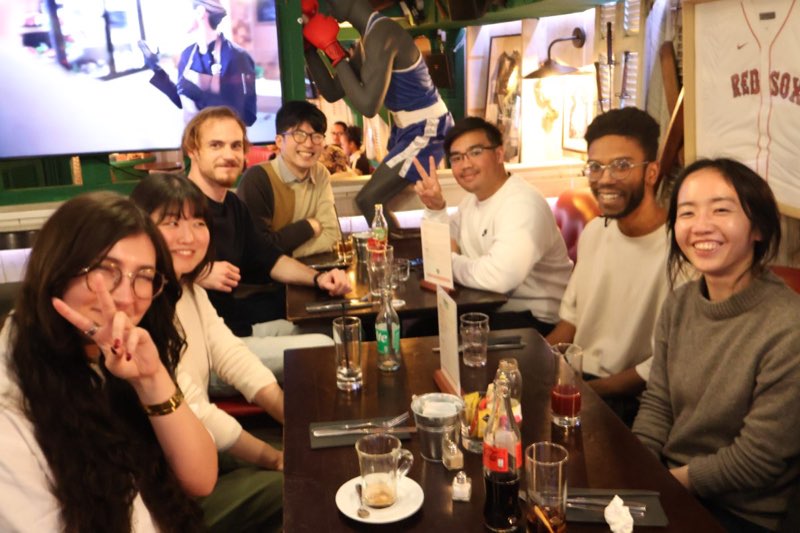
Most guides on hosting a language exchange are written by brands that have never run one. We organise in-person language exchange tables every week at Furamori, so this is the playbook we actually use: the eight decisions that make or break an evening, from choosing the café to what happens when people don't show up. Use it to start your own group in your city, or to understand why our tables work the way they do.
The 8 decisions that make a language exchange work
1. Choose a cosy café, indoors
The venue shapes the whole evening. We look for cosy cafés, calm or with soft music, with comfortable seating, and we avoid terraces whenever we can: outside, noise, wind and passers-by make it much harder to follow a conversation. There's a reason for this beyond comfort: research on listening in noise shows background noise makes a foreign language far harder to understand than your own, and people raise their voices as a room gets louder. A quiet room helps the learners most.
Two more things we check: the menu prices (nobody should feel they're paying a premium to practise) and whether the place is a little original. Discovering a café you didn't know is part of the fun.
2. Keep tables small: 4 to 8 people
Above a handful of people, one conversation naturally splits into two. A classic study on conversation groups found spontaneous conversations tend to cap at about four speakers. Our tables of 4 to 8 people let one conversation hold together, with room for a side chat when it splits.
3. Balance the languages before the evening, not during
The most common failure at open language nights is a table with three learners of English and no English speaker. We solve this before anyone arrives: every table is put together in advance so that each language has enough native speakers. Tandem-learning guidelines recommend each partner gets roughly half the time in each language; composing the table is the simplest way to make that possible.

4. Decide whether you need a host at each table
Many guides recommend a facilitator at every table. We made the opposite choice: there's no host at our tables, and nobody hands out speaking turns or makes people switch languages on a timer. It works because the tables are balanced in advance and because people come with a real interest in each other's language and culture, which gives conversations a natural thread. If your tables aren't balanced, a facilitator helps; if they are, people manage very well on their own.
5. Give people an easy way in
The first minutes are always a little slow. Simple questions that each person can answer from their own life (where they're from, why they're learning the language) get things moving, and studies on building closeness show that questions which become gradually more personal bring strangers closer. Our 88 language exchange topics are built for exactly this.
6. Plan for no-shows
For a big open night, a few no-shows don't matter. For a balanced table of six, two missing people break the balance. Event organisers widely report that free events see more no-shows than paid ones, which is one reason some small-format exchanges charge a small fee. Whatever you choose, collect sign-ups, send a reminder the day before, and keep a waitlist.

7. Pick a sign-up tool
| Tool | Good for |
|---|---|
| Meetup | Being discovered by people looking for groups in your city; recurring groups |
| Luma | Clean event pages, guest approval, waitlists and automatic reminders |
| Eventbrite | Ticketed events and larger audiences |
Pricing changes often on all three, so check their sites before choosing.
8. Agree on the basics with the venue
Before the first evening, agree with the café on the time, the number of tables, and that guests will give the booking name when they arrive so the staff can walk them to the table. Each participant orders and pays for their own drink, which is what makes the arrangement fair for the venue.

What happens when it works
When the venue, the table size and the language balance are right, the evening takes care of itself: people stay for 2 to 3 hours, swap Instagram at the end and many meet up again. Read how a language exchange works from the participant's side, and how we think about safety.
Want to host Furamori tables in your café?
We're opening new cities step by step, and we're always looking for cosy cafés and bars to host our tables, and for schools and associations to partner with. If you run a venue, see hosting Furamori; if you run a school or a community, see becoming a partner.
Frequently asked questions
How many people should be at a language exchange table?
What makes a good venue for a language exchange?
Do you need a host at each table?
How do you reduce no-shows at a language exchange?
Which tool should I use to organise a language exchange?
Sources: Dunbar, Duncan & Nettle (1995), "Size and structure of freely forming conversational groups"; Journal of the Acoustical Society of America (2018) on noise and conversation; Aron et al. (1997) on building closeness; tandem learning guidelines (Kyushu University); help pages of Luma, Meetup and Eventbrite. Checked in October 2026.