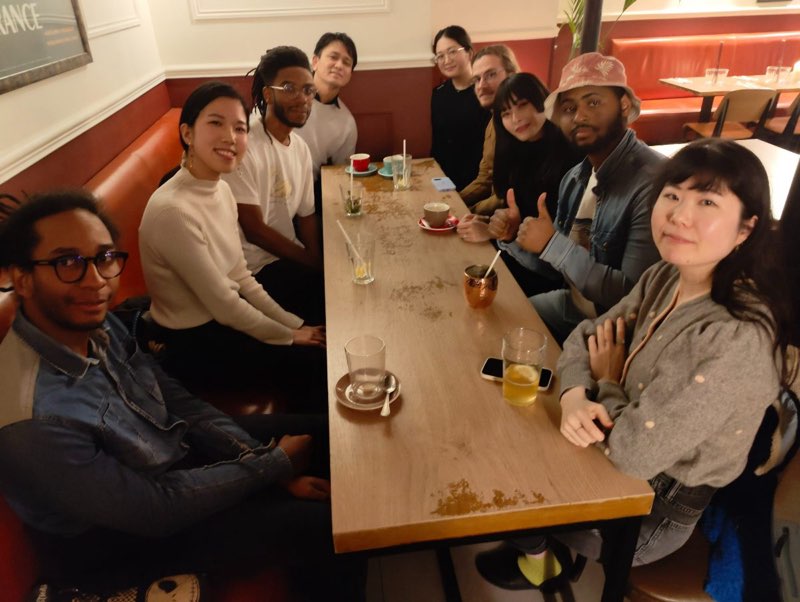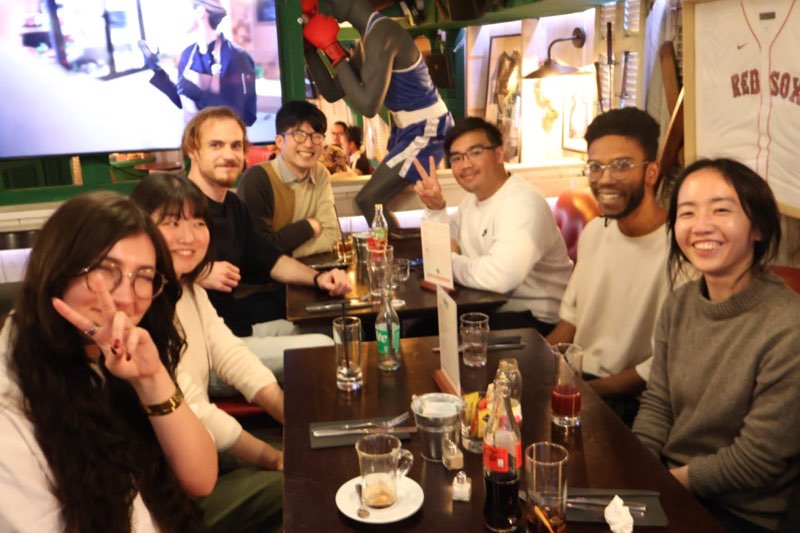

A language exchange is a conversation between people who speak different languages, where each person practises the other's language and helps them with their own. There's no teacher and no lesson, just conversation with native speakers. It can happen one to one, online or around a table in a café. At Furamori we run in-person language exchanges every week, and this guide explains how one actually works, from the moment you walk in to what happens after.
What is a language exchange?
The idea is simple: the fastest way to get comfortable speaking a language is to talk with someone whose native language it is. In return, you help them with yours. A French speaker learning English meets an English speaker learning French, and both leave having practised. Nobody pays the other, because everyone gives and receives the same thing.
You'll also hear it called a tandem, a language café, a polyglot night or a conversation exchange. They all share the same principle, but the format changes the experience a lot.
The 4 formats of language exchange
| Format | How it works | Best for |
|---|---|---|
| Apps (HelloTalk, Tandem…) | You chat with partners online, mostly by text and voice messages. | Practising anytime, writing and vocabulary |
| One-to-one tandem | You meet one partner, in person or on video, and split the time between both languages. | Steady practice, once you've found the right partner |
| Open polyglot night | A busy bar full of people; you walk around and look for speakers of the language you want. | People comfortable approaching strangers |
| Small pre-arranged tables | Tables of 4 to 8 people, put together in advance so that each language has native speakers at the table. | People coming alone, or who want real time with natives |
Furamori runs the last format. The rest of this guide describes what we see at our tables, week after week.

How an in-person language exchange works, step by step
Arriving: almost everyone comes alone
Most people come on their own, and for many it's their very first time. When you arrive, you just give the café or bar the booking name, Furamori, and the staff walk you to the table. Feeling a bit nervous is normal: meeting strangers in another language is intimidating for everyone.
The first minutes: a slow start
Nobody knows each other yet, so the beginning is always a little quiet. People introduce themselves, say where they're from and why they're learning the language. Then, at some point, someone says something interesting, and the others pick up on it.
Why the ice breaks on its own
This is what struck us most. At a generic "meet new people" event, two strangers often have nothing in particular to say to each other. At a language exchange, everyone comes with a real interest in the other person's language and culture. When a Japanese participant talks about life in Japan, the French participant learning Japanese always has a question, a story or a travel memory to share. Connections happen surprisingly naturally.
No host, and it still works
This is what surprises newcomers the most: at our tables there's no host. Nobody hands out speaking turns or makes you switch languages every fifteen minutes. People talk with whoever they like, and the languages balance themselves, because the work is done beforehand: every table is put together in advance so that each language has enough native speakers.
An evening of 2 to 3 hours
A session usually lasts 2 to 3 hours. That surprised us at first too. But finally getting to talk with native speakers, in a relaxed setting, makes people want to stay. Of course, everyone is free to leave whenever they like.
Afterwards: Instagram, karaoke and friendships
At the end, people often swap Instagram accounts. Many meet up again: we've seen stories from participants getting together after a session, and some have formed groups to go to karaoke together. A lot of friendships have started around these tables.

Do you need a good level?
No. Beginners are welcome. Listening to native speakers talk with each other is part of learning too: you hear the language as it's really spoken, with its rhythm and expressions, which no textbook shows you. You can join in at your own pace and mix both languages when you need to. And at every table there are people learning your language, so they know exactly what it feels like to search for words.
Most participants are people who work in the city, locals and expats alike, along with students.
Does a language exchange actually work?
It works for what it's designed for: speaking. A language exchange won't replace grammar lessons, but it gives you what classes and apps rarely do: hours of real conversation with native speakers, at natural speed, about things you actually care about. It's also where many people get over the fear of speaking, because everyone at the table is in the same position in one language or the other.
It works best when you come back regularly. The first session breaks the ice; the following ones are where you start to feel the difference, and where acquaintances become friends.
5 tips for your first language exchange
- Come alone without hesitating: that's what almost everyone does.
- Prepare 2 or 3 things you love talking about: a trip, a series, what made you want to learn the language. That's often where the conversation takes off. Need ideas? Here are 88 language exchange topics that work at a real table.
- Ask questions: people love talking about their country, their city and their culture.
- Leave room for others: a good table is one where everyone got to speak.
- Swap contacts at the end: that's how conversations turn into friendships.

Find a language exchange near you
Furamori runs in-person language exchanges every week and is opening new cities step by step. See all Furamori cities, or go straight to our language exchange in Paris. If you've only tried apps so far, our guide to French conversation groups in Paris compares the in-person options in one city.
Frequently asked questions
What is a language exchange?
How does an in-person language exchange work?
Do I need to be fluent to join a language exchange?
Can I go to a language exchange alone?
Does a language exchange really help you learn?