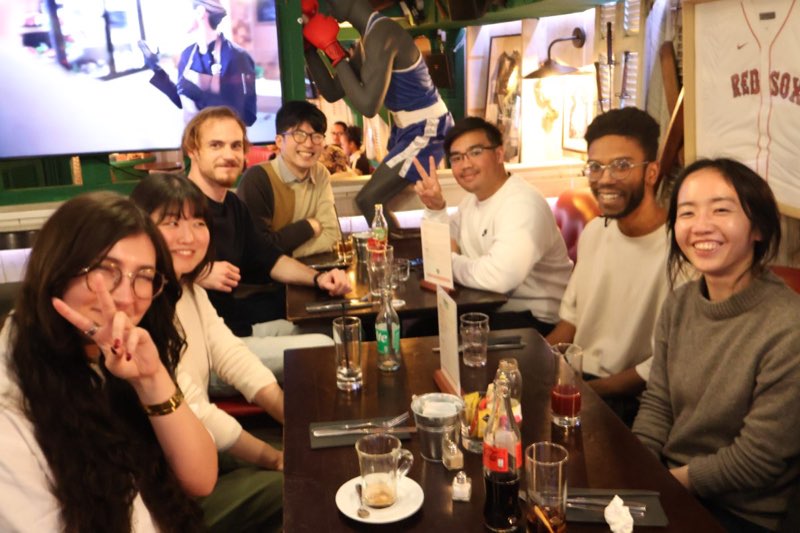
Almost everyone knows the fear of speaking a foreign language: searching for words, making mistakes, not understanding the answer, sounding less intelligent than you are. We could give you a list of tips. Instead, here's what we actually see at our language exchange tables, through the story of one participant, followed by what native speakers really think of your mistakes.
A first table, told from the inside
He didn't speak Japanese very well
A French participant came to one of our French-Japanese tables knowing his Japanese wasn't very good. It was his first table. The first minutes are always a bit slow, at every one of our tables: nobody knows each other yet, people introduce themselves, everyone searches for words.
The question that unlocked everything
What turns the evening around is almost never a technique. It's a question. Someone asked him why he was learning Japanese, and what drew him to Japanese culture. It's the simplest question there is, and that's exactly why it works: it was the reason he was there. On that subject he had things to say, and wanting to say them won out over the fear of saying them badly.

What he discovered: his gaps, and what to do about them
He really enjoyed the evening. More importantly, speaking for real with native speakers showed him exactly where his gaps were, and what he needed to work on to improve. That's something you can't see on your own with a textbook or an app: until you speak, you don't really know what's holding you back. The fear of speaking badly turns into something else, a list of things to work on.
Why he comes back
He now comes back from time to time. For the atmosphere, but also to stay in a learning rhythm: coming back to a table now and then helps him keep going.
What native speakers really think of your mistakes
This is often the scariest part: how the person whose language it is will see you. Here's what we see at our tables.
- They understand. They make mistakes in your language too, or have been beginners themselves. At a language exchange table, everyone is a learner in one language or the other.
- They like helping. A real exchange happens: everyone helps the other in their own language, and people especially like helping someone who's learning theirs.
- It's flattering. Someone making the effort to learn your language is always touching. Your mistakes don't say "I speak badly", they say "your language matters to me".
Flip it around: when a foreigner tries to speak your language with mistakes, do you laugh at them, or are you glad they're trying? Others feel the same way about you.

Where the fear comes from, and why it fades
The fear of speaking rarely comes from your level itself. It comes from the judgement you imagine in the other person, and from the idea that you should speak perfectly before you're allowed to speak at all. It fades when experience proves both ideas wrong: when you see that the other person is kind, and that you improve precisely by speaking badly first. Reading tips doesn't change much. Living through a conversation that goes well does.
3 things to remember
- At a language exchange, everyone is learning. Nobody expects you to speak perfectly, since nobody does in the other person's language.
- Prepare your answer to "why are you learning this language?" It's the question that will come up, and the one that will get you talking, because you genuinely have something to say. You can even rehearse it out loud with an AI first: here's how to practise speaking with AI, and more ideas in our language exchange topics.
- Your first time is for seeing what holds you back. It's not an exam. Leaving with a clear idea of what to work on is already a success, and coming back is what makes you improve.

Try it at your own pace
At Furamori we run tables of 4 to 8 people every week, put together in advance so each language has native speakers. Beginners are welcome, and listening is part of learning too. Read how a language exchange works or see all Furamori cities.
Frequently asked questions
How do I get over the fear of speaking a foreign language?
Do native speakers judge your mistakes?
Can I join a language exchange as a beginner?
How do I start speaking when I freeze up?